
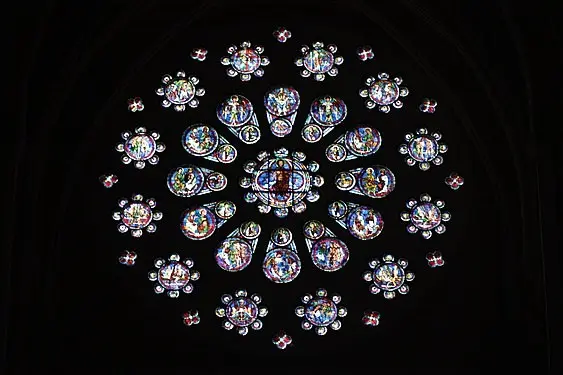
The Rose Window of Chartres Cathedral refers to three major rose windows located in the west, north, and south transepts, each a masterpiece of Gothic stained glass art with distinct themes and historical significance. The west rose window, the largest of the three at 15.42 meters in diameter, dates to around 1215 CE and depicts the Last Judgment, with Christ as the Judge at the center, surrounded by angels, the Elders of the Apocalypse, and scenes of resurrection and judgment. Positioned on the west-facing wall, it captures the light of the setting sun, symbolizing the end of time.
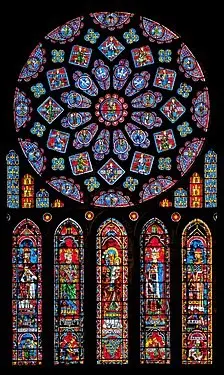
The north transept rose window, dating to around 1235 CE, dedicated to the Virgin Mary, features the Virgin and Child in the central oculus, surrounded by doves, angels, and the 12 kings of Judah, who are Christ’s ancestors. The House of France funded this window, specifically King Louis IX and his mother, Blanche of Castile, and the window includes the fleur-de-lis, the French royal coat of arms, in its design. The lancet windows below depict Old Testament figures such as Saul, David, Solomon, and prophets like Jeremiah and Isaiah, illustrating the fulfillment of prophecy through Mary.
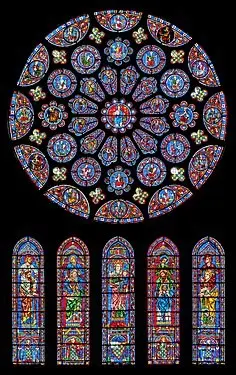
The south transept rose window, created between 1221 and 1230 CE, dedicated to Christ’s triumph, shows him in benediction, surrounded by the 24 Elders of the Apocalypse, who are holding medieval musical instruments. The central lancet beneath it portrays the Virgin and Child, flanked by the evangelists seated on the shoulders of Old Testament prophets, symbolizing the New Testament building upon the Old. This window’s design reflects the theme of Christ’s second coming and the Kingdom of God.
All three rose windows are integral to the cathedral’s architectural and liturgical design, reinforcing the cruciform shape of the building and serving as visual narratives of Christian theology. The windows were crafted through the collaborative efforts of masons, glaziers, and metalsmiths, with their design carefully integrated into the overall structure, including buttresses and Clerestory rosettes. The north rose window, in particular, is noted for its intricate tracery and radial symmetry, which some interpret as a visual representation of cosmic harmony and vibrational frequencies, such as the 528 Hz “Love Frequency”. The windows, along with the cathedral’s other stained glass, were intended to be educational, conveying biblical stories and theological concepts to a largely illiterate population.
Sources:
- North Rose Window by GOTHIC GLASS PAINTER, French
- Stained glass windows of Chartres Cathedral - Wikipedia
- STAINED GLASS – American Friends of Chartres
- What’s in a Rose? Glazing the Rose Windows of Chartres Cathedral – American Friends of Chartres
- The Enigmatic Rose Window of Chartres Cathedral: A Portal to Cosmic Harmony via Cymatics | by The Cathedral Code | Medium
- Title Unavailable | Site Unreachable
- Title Unavailable | Site Unreachable
- Stained Glass At Chartres Cathedral – gardeninacity