
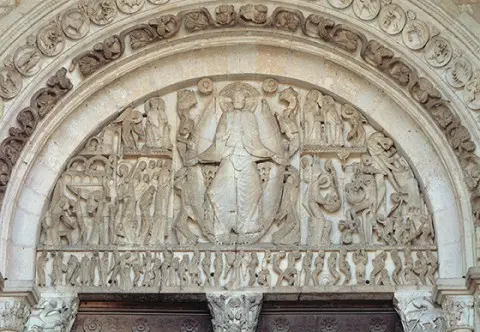
The Last Judgment relief sculpture by Gislebertus, located on the west tympanum of the Cathedral of Saint-Lazare in Autun, France, is a monumental work of Romanesque created between 1130 and 1135. Dominated by a large, serene Christ enthroned within a mandorla, the composition features elongated figures and dramatic scenes that convey the theological message of the impending Last Judgment. Christ is flanked by the Virgin Mary and apostles depicted as penitents and observers of the judgment. To the right, St. Peter guards the entrance to the Heavenly Jerusalem, where resurrected souls struggle to enter with the help of angels. On the left, the Weighing of the Souls takes place between the Archangel Michael and the Devil, with a demon attempting to tip the scales, and Luxuria, depicted with snakes at her breasts, standing behind Michael. The architrave below shows the separation of the Elect and the Damned, with a frightened crowd of the damned being pulled into Hell by demons
The tympanum was designed to serve as a powerful visual educational tool for the largely illiterate medieval population, using dramatic and terrifying imagery to inspire fear and moral reflection on one’s actions. An inscription beneath the sculpture states, “May this terror terrify those whom earthly error binds for the horror of the images here in this manner truly depicts what will be,” explicitly confirming its intent to instill dread and caution. The work is also notable for the sculptor’s signature, “Gislebertus hoc fecit” (Gislebertus made this), inscribed in the lower center of the tympanum, a rare occurrence in medieval art that elevates the artist’s status. The tympanum was covered in plaster in 1766 due to its perceived offensive nature and was rediscovered and restored in 1837, with Christ’s head being reattached in 1948. The sculpture is framed by inner and outer archivolts, with the outer medallions depicting the labours of the months and signs of the zodiac, placing the Last Judgment within a broader cosmic context
Sources:
- Tympanum of the main portal by GISLEBERTUS
- Last Judgment by GISLEBERTUS
- CONA Full Record
- Last Judgment, by Gislebertus (ca. 1130) | The Christian Century
- Last Judgment, Atun Cathedral – gqstimeline.com
- Autun Cathedral - Wikipedia
- Site Unreachable
- Art & Culture: 104: Last Judgment, Gislebertus
- Art Writings: Gislebertus and the Last Judgement
- Gislebertus’s Last Judgment - (Intro to Humanities) - Vocab, Definition, Explanations | Fiveable | Fiveable
- Gislebertus | Master of Autun, Romanesque, Cathedral | Britannica