
The Justinian and Theodora panels in the Church of San Vitale in Ravenna, Italy, are two of the most renowned mosaics from the early Byzantine period, created around 547 CE. These mosaics are located on opposite sides of the Apse, facing each other, and depict Emperor Justinian I and Empress Theodora with their respective retinues in a liturgical procession. The panels serve as powerful symbols of imperial authority and divine right, asserting the political and religious power of the Byzantine Empire following its conquest of Ravenna from the Ostrogoths in 540 CE.
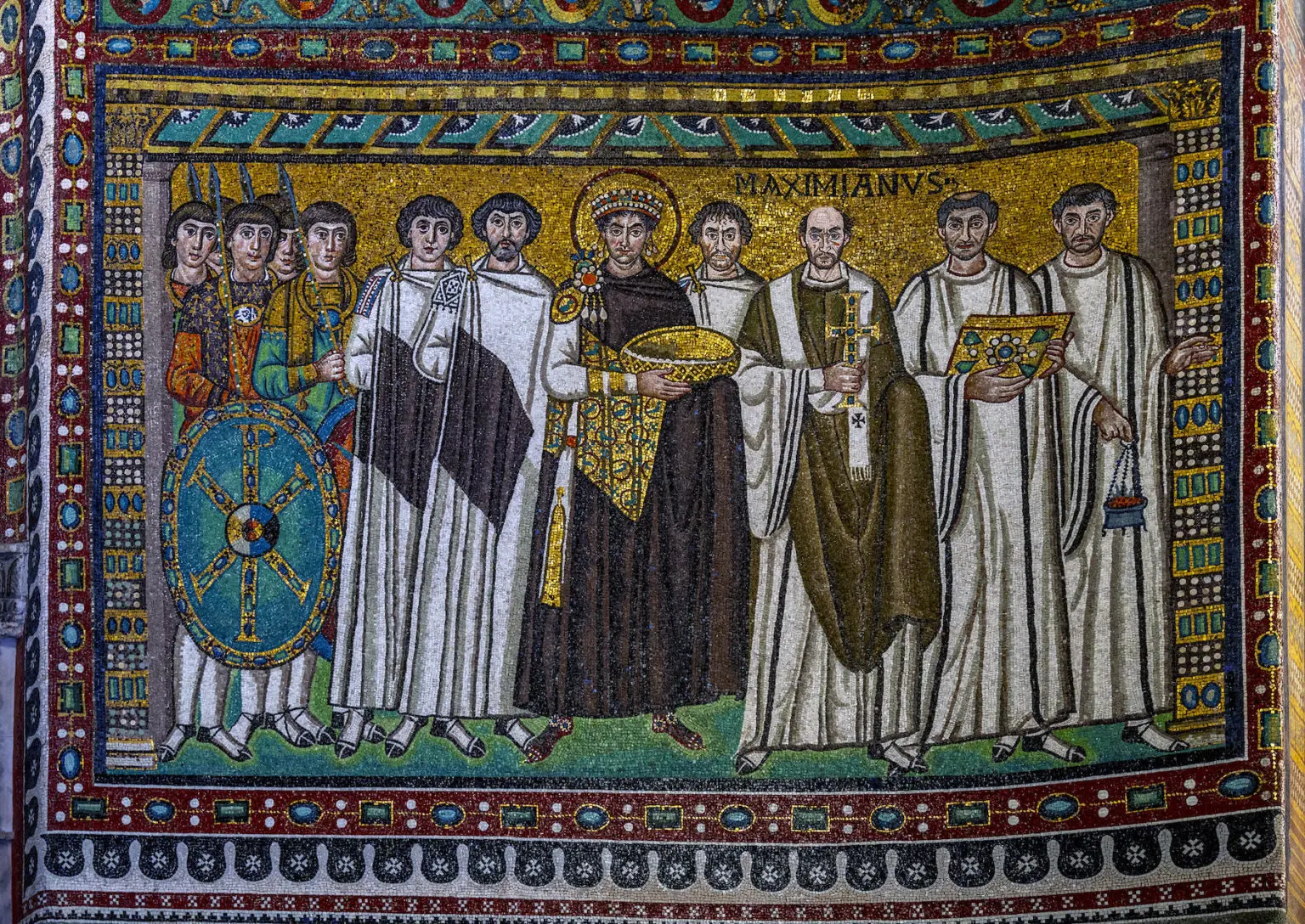
In the mosaic of Emperor Justinian, he is shown on the left side of the Apse, wearing a white tunic and a purple chlamys, a cloak associated with high status, and a gold and gemmed tablion across his shoulder. He holds a large gold paten, used to hold the Eucharistic bread, and is positioned centrally within a V-shaped formation of courtiers, clergy, and soldiers, emphasizing his leadership over both church and state. To his left stands Bishop Maximianus, identified by an inscription, holding a jeweled cross, while to his right are generals and officials, including Belisarius, the conqueror of Ravenna. The gold background signifies the sacred and eternal nature of the scene.
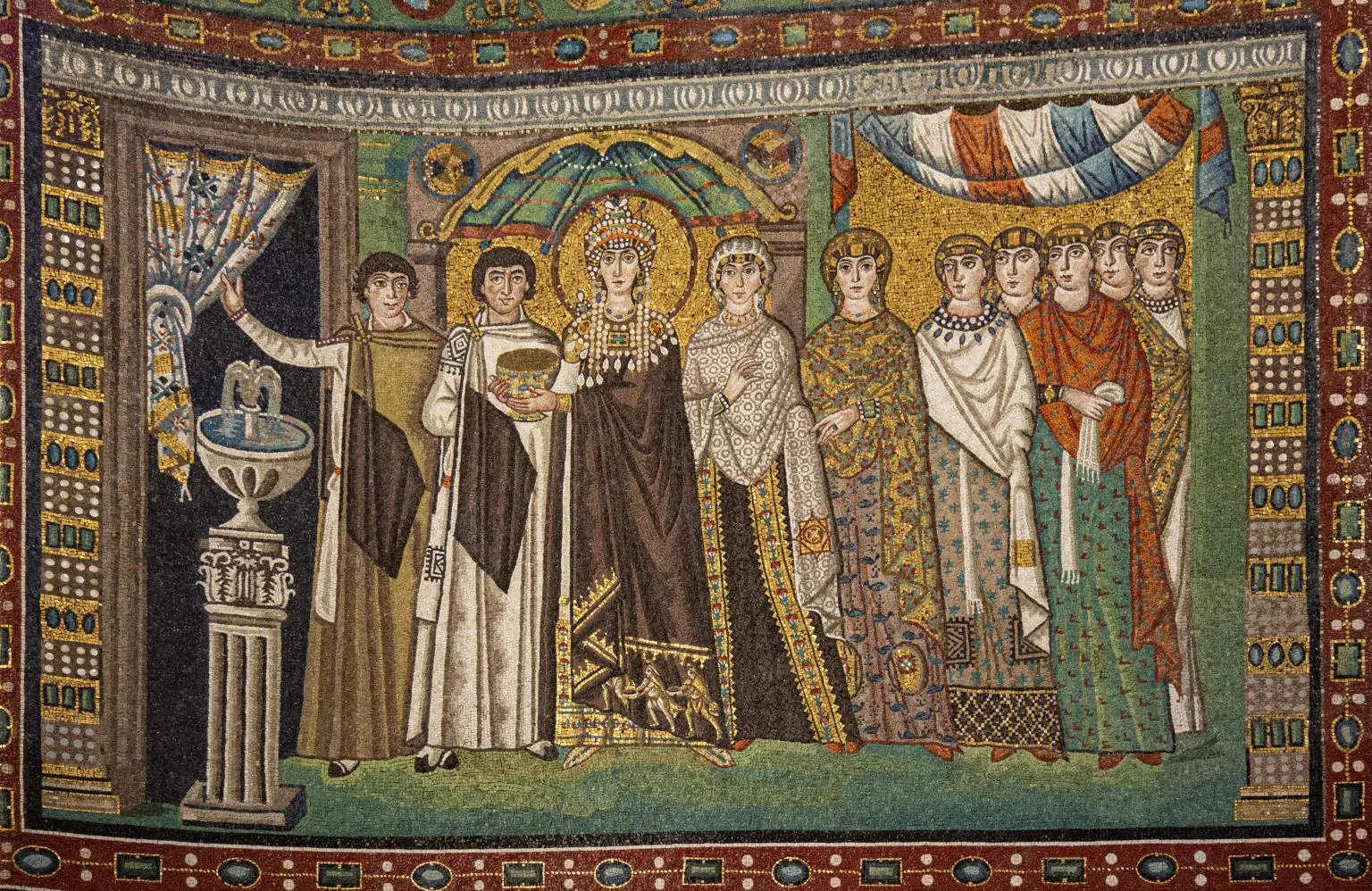
On the opposite side, Empress Theodora is depicted with a similar level of regal splendor, holding a chalice for the Eucharistic wine. She wears a richly adorned gown with a wide band at the hem that features a depiction of the Three Magi, symbolizing the offering of gifts, reinforcing the idea of her procession as a sacred offering. Her court includes female attendants and male dignitaries, with one man holding back a curtain to allow her passage, suggesting a ceremonial entry into the church. The architectural setting behind her, including a fountain and columns, evokes the opulence of the imperial court.
Both emperors are shown with halos, a visual cue for their divine right to rule, though not for sainthood. The mosaics are not literal depictions of actual events, as Justinian and Theodora never visited Ravenna, but rather serve as ideological statements to reinforce Byzantine authority and religious legitimacy in the newly conquered territory. The mosaics are celebrated for their intricate details, including individualized facial features, realistic shadows, and the lavish depiction of Byzantine imperial dress, such as purple garments and jeweled crowns, which provide invaluable insight into 6th-century court fashion.
The mosaics measure approximately 8 feet 8 inches by 12 feet (264.2 cm by 365.8 cm), making them life-sized and imposing in scale, contributing to their dramatic impact. They are part of a larger decorative program in San Vitale that includes scenes from the Old and New Testaments, as well as the Christ in Majesty in the dome, all emphasizing the connection between earthly power and divine order. The Church of San Vitale, with its octagonal structure and rich mosaics, was designated a UNESCO World Heritage site in 1996, recognizing its significance as a masterpiece of early Byzantine art and architecture.
Sources:
- Ravenna’s Treasures: Mosaics in San Vitale | DailyArt Magazine
- Dress Styles in the Mosaics of San Vitale | The Metropolitan Museum of Art
- San Vitale Mosaics: Justinian & Symbolism | StudySmarter
- Basilica of San Vitale - Mosaic Art - Justinian and Theodora Panels | Justinian Theodora Panels
- Title Unavailable | Site Unreachable
- Basilica of San Vitale
- art - What size are these mosaics of Justinian and Theodora? - History Stack Exchange
- Title Unavailable | Site Unreachable
- 545-549 CE – Imperial Mosaics of the Basilica of San Vitale | Fashion History Timeline
- Justinian Mosaic (San Vitale)