
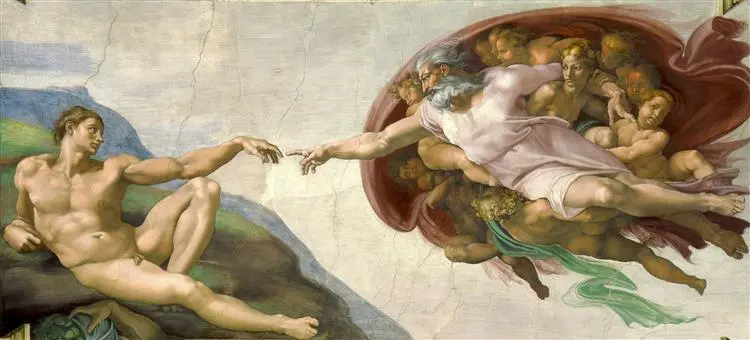
The Creation of Adam is a renowned fresco painting by Italian artist Michelangelo, created between 1508 and 1512 as part of the decoration of the Sistine Chapel ceiling in Vatican City. It illustrates the Biblical creation narrative from the Book of Genesis, depicting the moment when God imparts life to Adam, the first man. The painting is the fourth in a series of nine central panels on the ceiling, which depict key episodes from the Genesis creation story
Michelangelo was originally commissioned to paint the Twelve Apostles on the pendentives and to decorate the central ceiling with ornamental designs, but he persuaded Pope Julius II to allow him a more ambitious scheme that included complex scenes from Genesis, the Fall of Man, the Promise of Salvation, and the genealogy of Christ. The composition features God, depicted as an elderly, muscular man with a long beard, floating in a swirling cloak surrounded by angels, reaching out to touch Adam, who lies on the ground, his hand extended in a mirrored pose. The near-touching index fingers of God and Adam have become one of the most iconic images in Western art, symbolizing the transfer of divine life
The painting is celebrated for its masterful depiction of human anatomy and its symbolic depth. The figures of God and Adam are positioned in complementary convex and concave forms, reflecting the idea that humanity was created in the image and likeness of God. The background figures and shapes surrounding God have been interpreted by some scholars as resembling the human brain, with the red cloth forming the outline of the cerebrum and other anatomical features. Other interpretations suggest the red mantle represents a human uterus, and the green scarf could symbolize an umbilical cord, implying a metaphorical birth of humanity. A 2019 study noted an extra concealed rib in Adam’s torso, possibly representing Eve, which could reflect Michelangelo’s challenge to the traditional Catholic narrative of Eve being created after Adam
The fresco is part of a larger scheme that includes over 300 figures, with the pendentives adorned by prophets and Sibyls who foretold the coming of Christ. The painting has been reproduced in countless imitations and parodies and is considered one of the most replicated religious artworks in history. It was restored during a major cleaning campaign from 1977 to 1989, which dramatically revealed the original vibrant colors and details, significantly enhancing its visual impact
Michelangelo’s Creation of Adam remains a cornerstone of High Renaissance art, embodying both the artistic genius of its creator and the profound theological themes of the era.
Sources:
- The Creation of Adam - Wikipedia
- “The Creation of Adam” by Michelangelo - An In-Depth Analysis
- The Creation of Adam by Michelangelo: The God and Human
- Michelangelo’s Creation of Adam in the Sistine Chapel
- Sistine Chapel Ceiling: Creation of Adam, 1510 - Michelangelo - WikiArt.org
- Michelangelo’s The Creation of Adam: A Timeless Masterpiece |1st Art Gallery
- Michelangelo’s Creation of Adam
- The Creation of Adam, by Michelangelo
- The Creation of Adam (c.1508 - 1512): Michelangelo’s Astounding Piece