
Oath of the Horatii
Type: Painting
Medium: Oil on canvas
Genre: History painting
Themes: war, politics, myth
Artist: Jacques-Louis David
Movement: Neoclassicism
Region: France
Period: 18th Century
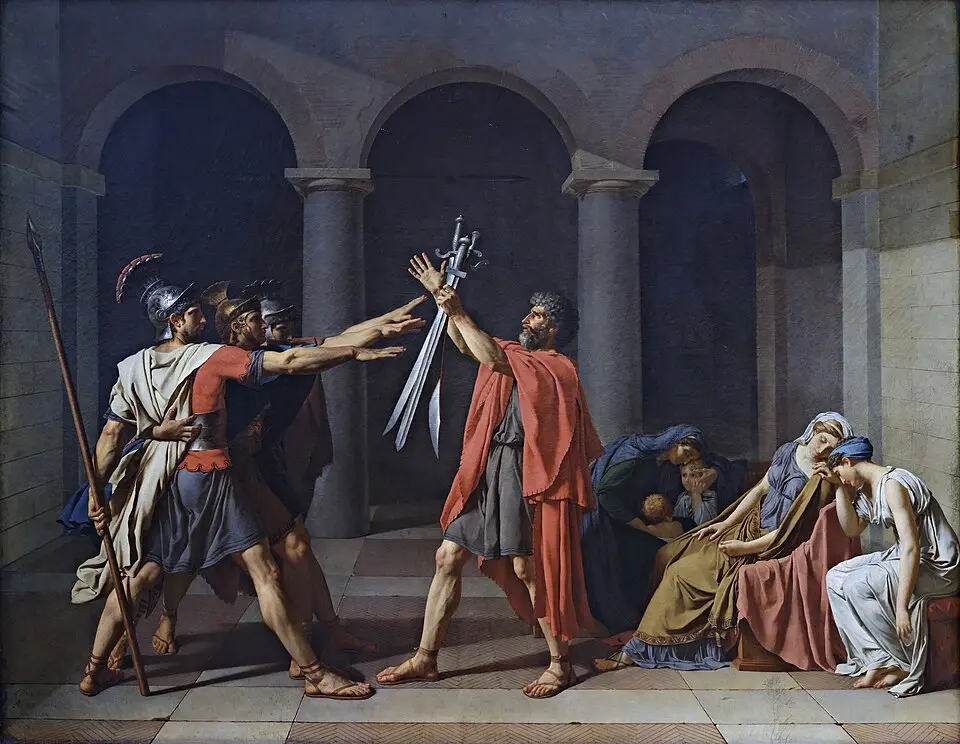
Basic Information:
- Current Location: The Louvre, Paris
- Significance: One of the best-known paintings in Neoclassical style; became a defining image of pre-Revolutionary France
The Story Depicted:
- Based on a Roman legend from the 7th century BC about a dispute between Rome and Alba Longa
- Instead of full war, each city chooses three champions to fight
- Three Horatii brothers from Rome agree to fight three Curiatii brothers from Alba Longa
- The painting shows the brothers swearing an oath before their father, who holds out their swords
- Only one Horatii brother survives, but he defeats all three Curiatii by separating them
Key Elements in the Painting:
- Left side: Three Horatii brothers saluting their swords, showing no emotion
- Center: The father holding three swords, emotionless
- Right side: Three weeping women and two children
- Camilla (in white): A Horatii sister betrothed to a Curiatii
- Woman in brown: A Curiatii married to a Horatii
- Both will lose loved ones regardless of outcome
Themes & Symbolism:
- Patriotic duty over personal feelings - men willing to sacrifice for the state
- Gender contrast: Resolute, taut men vs. tender, weeping women
- Reflects political tensions as French Revolution approached (painted 1784, Revolution 1789)
- Emphasizes loyalty to the state rather than family or church
Historical Context:
- Commissioned by King Louis XVI’s assistant as an allegory about loyalty to the state/king
- David changed the agreed-upon scene to his own invention
- Ironically, David later voted for Louis XVI’s execution during the Revolution
- Sources: Livy’s Ab Urbe Condita and Dionysius’s Roman Antiquities
Artistic Technique:
- Simple yet powerful use of tonal contrasts
- Clear compositional divisions between male/female, duty/emotion
- Neoclassical style emphasizing clarity and moral purpose
Reception:
- Immediate success with critics and public
- Even the Pope requested a viewing in Rome
- Initially displayed poorly at the 1785 Paris Salon, but public demand forced it to be moved to a prominent location
- Enhanced David’s fame and allowed him to take on students